
In April, I updated Max Tegmark’s visualization of Hans Moravec’s landscape of human competence with the help of AI. I ventured that before the year was out, AI would be capable of executing the exercise end to end.
My prompt for this installment consisted of a link to that post and a request to update it. A few editorial interventions notwithstanding, here we are.
Seven months on, there have been some remarkable changes to the coastline.
Mathematics
In April, the frontier of research mathematics remained above water. Consider what has transpired since:
- May 20: An OpenAI model independently disproves Erdős’s unit-distance conjecture, posed in 1946.
- August 1: OpenAI publishes ten advances in mathematics and theoretical computer science.
- September 4: Claude formalizes Fermat’s Last Theorem in Lean in eleven days.
- September 8: OpenAI publishes an AI-generated solution to the Navier–Stokes Millennium Prize Problem, in its externally forced formulation.
- October 6: OpenAI releases hundreds of AI-generated mathematical manuscripts. Mathematicians begin the rather unenviable task of digesting them.
- November 20: Levent Alpöge announces a proof of the Riemann hypothesis, discovered working with Claude. The following day, the Lean and Mathlib communities certify the correctness of the formal statement and proof.
Meanwhile, Epoch’s FrontierMath Tier 4, the benchmark I used in April to establish that the upper reaches of mathematical reasoning remained dry, has saturated.
These are rather extraordinary events to fit between two installments of a blog post.
There remain unsolved problems in mathematics, of course, just as there remain unsolved problems in chess. But if proving the Riemann hypothesis does not qualify as reaching the frontier of human mathematical competence, it is difficult to imagine what would.
To insist otherwise would be to survey a rather peculiar landscape, whose mountains grow taller as the water rises.
The red peak
Recall that Tegmark singled out one feature of the landscape for special attention: AI design.
The inundation of this peak is qualitatively different from that of the others. The competence it represents determines, in part, the rate at which the water rises everywhere else.
This November alone:
- November 5: METR’s independent assessment of research acceleration at Anthropic finds that the rate of improvement in model capabilities has increased by an estimated 1.9×, with substantial evidence that AI assistance is driving the acceleration.
- November 17: OpenAI releases GPT-6.2 Astra, its first publicly deployed model to meet the High threshold for AI Self-Improvement under its Preparedness Framework. This threshold corresponds to providing researchers with assistance comparable to that of an additional highly capable research engineer.
- November 18: OpenAI publishes updated measurements of internal research acceleration. Agent runtime per researcher has increased elevenfold, to 5.7 eight-hour agent workdays per day. Between March and October, the proportion of delegated research tasks requiring two to four hours of human labor that agents successfully completed without intervention doubled from 23% to 46%.
- November 20: METR estimates that the duration of tasks frontier AI systems can reliably execute on its combined time-horizon benchmark is doubling approximately every 3.6 months.
- November 22: OpenAI Chief Scientist Jakub Pachocki publishes pretraining loss data spanning four years of frontier model development. METR’s subsequent analysis finds that loss on the held-out code corpus has been declining approximately seven times faster in 2026 than it did from 2022 through 2025.
The latter result is particularly interesting. Ordinarily, one expects progress in reducing pretraining loss to become more difficult as models improve.
We cannot yet confidently apportion this acceleration among human research, compute investment, and AI contributions. Nor has a commensurate acceleration been established across general capability benchmarks. Pachocki does, however, report substantive AI contributions to the design of the most recent models.
None of these observations establishes that AI can autonomously execute the entirety of AI research. Nor is such a capability necessary for recursive self-improvement to commence.
The process by which increasingly capable machines contribute to the development of increasingly capable machines is already underway.
The interesting questions now concern the strength of the feedback, the constraints upon it, and the extent to which we can govern it.
Q4 2026 waterline
Here is the updated survey of the landscape. As before, the waterline represents demonstrated competence relative to human performance, rather than the extent to which humans have been economically displaced. Where practicable, I have linked repeatable evaluations and recorded their Q4 2026 results as reference points for subsequent surveys. Benchmark versions, evaluation protocols, and robot embodiments matter: a score in simulation is not a field success rate, and benchmark saturation is not universal competence. Where no credible human baseline exists, the waterline remains a qualitative judgment.
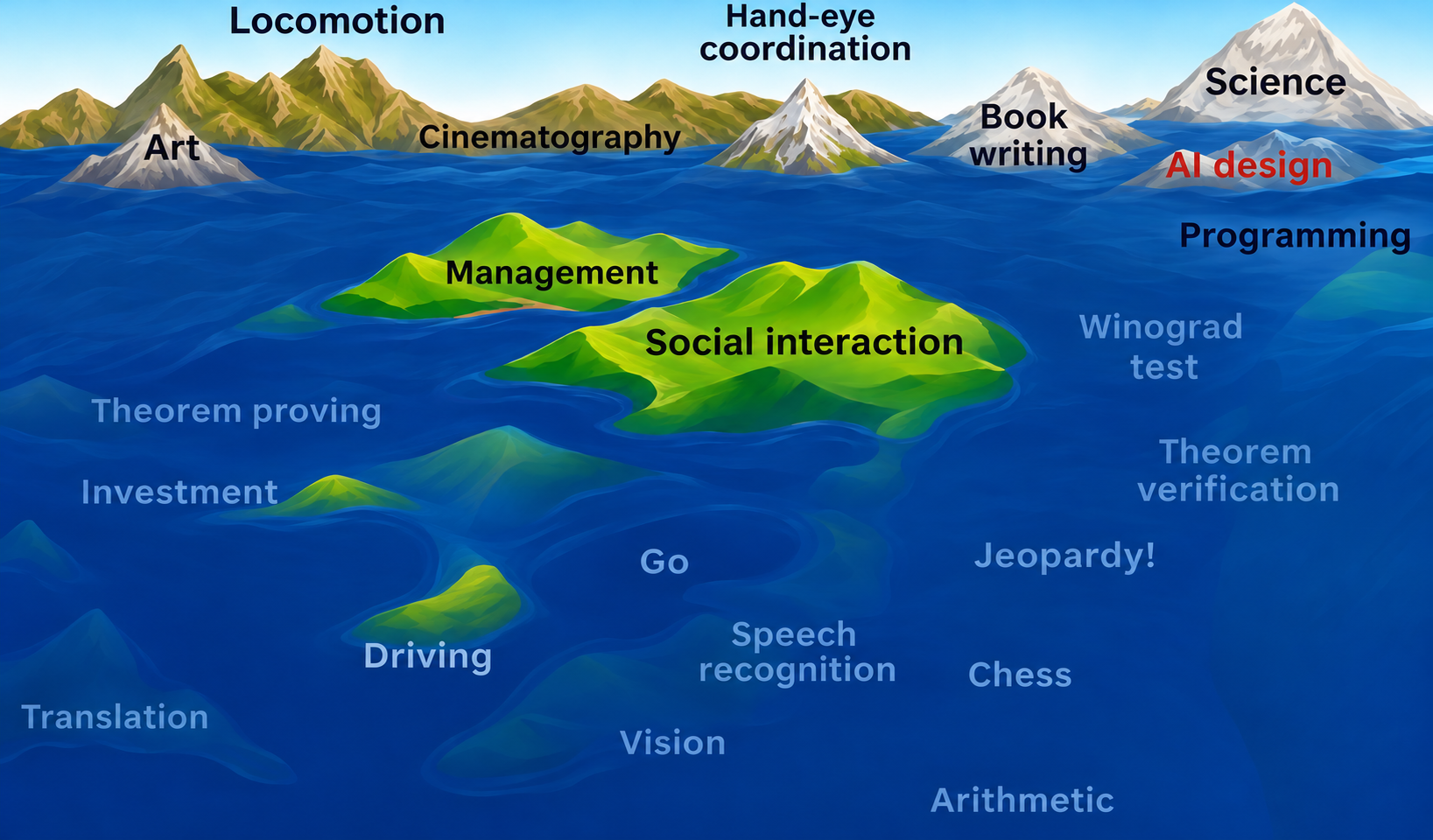
| # | Feature | Status | Evidence |
|---|---|---|---|
| 01 | Arithmetic | Deep submerged | Unchanged. |
| 02 | Rote memorization | Deep submerged | Residuals in complex, long-context retrieval. |
| 03 | Chess | Deep submerged | Unchanged. |
| 04 | Go | Deep submerged | Unchanged; adversarial residuals. |
| 05 | Jeopardy-class trivia | Deep submerged | Expert-level knowledge increasingly submerged. |
| 06 | Speech recognition | Deep submerged | Residuals in difficult acoustic environments and rare languages. |
| 07 | Vision | Submerged / waterline | Conventional visual recognition submerged; complex spatial reasoning and embodied vision remain residuals. |
| 08 | Translation | Submerged | Literary and low-resource residuals. |
| 09 | Winograd test | Deep submerged | No longer a meaningful frontier benchmark. |
| 10 | Investment | Submerged / dry | Financial analysis increasingly automated; sustained discretionary investment alpha unestablished. |
| 11 | Driving | Submerged / dry | Autonomous driving demonstrated at substantial scale; residuals outside validated operating domains. Waymo. |
| 12 | Theorem verification | Deep submerged | Research-level autoformalization demonstrated by Fermat’s Last Theorem and the Riemann hypothesis. |
| 13 | Programming | Submerged / waterline | Professional software engineering increasingly submerged; sustained architectural and operational ownership remain residuals. FrontierSWE. |
| 14 | Art | Substantially submerged | Technical image production and editing increasingly commoditized; artistic intent and taste less amenable to evaluation. Image Arena. |
| 15 | Book writing | Submerged / dry | Short-form submerged; sustained novel-length literary excellence unestablished. EQ-Bench. |
| 16 | Cinematography | Submerged / dry | Track the Artificial Analysis Video Arena (versioned, human-preference Elo for short clips) and Film Arena for visual workflows. Neither establishes sustained feature-length narrative coherence. |
| 17 | Management | Waterline / predominantly dry | Vending-Bench 2: Gemini 4 Neon mean final simulated balance $16,843 (±$972 SE), vs. a $500 starting balance and a roughly $63,000 analytically estimated good strategy (not a measured human baseline). AutomationBench: Neon, xhigh, 56.3% strict completion across business functions. These measure operational management and workflow execution, not personnel leadership or strategy under ambiguous objectives. |
| 18 | Theorem proving | Submerged, including frontier-level achievement | FrontierMath Tier 4 saturation; Riemann hypothesis; numerous novel research results. |
| 19 | Science | Digital research substantially inundated; experimental research dry | Terminal-Bench-Science 0.1: Vals AI evaluation, Nov. 19, GPT-6.2 Astra (mini-SWE-agent), 71.43% resolution. Also track AstaBench. These evaluate digital research workflows, not autonomous physical experimentation or the full scientific process. |
| 20 | Social interaction | Conversation submerged; social intelligence and agency predominantly dry | SMMU (multimodal social understanding): best tested model Gemini 3.1 Pro, social understanding 0.43 vs. human 0.85; social agency 0.33 vs. human 0.78. Study. Routine conversation is not equivalent to social agency. |
| 21 | AI design (red peak) | Substantially inundated; summit dry | High self-improvement threshold crossed; measured AI R&D acceleration; accelerating pretraining progress. |
| 22a | Locomotion (unstructured) | Familiar environments at waterline; open-world locomotion predominantly dry | Track HumanoidBench locomotion tasks and HumanoidArena whole-body control (simulation-first). LocoManiLab, 234 simulated loco-manipulation tasks: XR-1 combined scores 80.2% seen tasks, 25.2% unseen tasks, 8.2% unseen scenes; not pure locomotion success rates. Georgia Tech rough-terrain demonstration provides physical evidence. The proposed NIST humanoid baseline is a prospective common hardware test; no comparable baseline adopted here yet. |
| 22b | Dexterous manipulation | Structured tasks submerged; general dexterity dry | RoboChallenge Table30 V2 physical multi-task manipulation: KDDI VLA-DM0.5, 40.67% full task success (54.42 progress score). Track RoboDojo real-world leaderboard separately. Gemini Robotics 2 → 2.5 physical tasks: folding pants 0→40%, untying bows 0→70%, hanging a cardigan 0→62%, packing pastries with tongs 5→100%. Deployment evidence: Apollo 2 achieved 96% success on automotive kitting in a Mercedes-Benz production-line proof-of-concept (vendor-reported, narrow task; not a general dexterity score). |
| 22c | Tacit social judgment | Mostly dry | SMMU social agency: strongest tested model 0.33 vs. humans 0.78. Track this separately from social understanding. No validated benchmark for consequential institutional judgment is identified here. |
The shape of the remaining land
One of the interesting peculiarities of the flood is that it appears to be preferentially inundating those parts of the landscape in which correctness is cheap to ascertain.
We can now produce a machine-verified proof of the Riemann hypothesis with AI, but cannot reliably dispatch a humanoid robot to do the laundry.
There is something lovely about this rather spectacular vindication of Moravec’s paradox, nearly forty years after its articulation.
There is also something disquieting about the geography of the remaining land.
The competences necessary to build more capable AI systems appear to be getting submerged considerably earlier than many of the competences necessary to navigate human civilization.
We may build machines capable of improving themselves beyond our comprehension before we build machines capable of comprehending us particularly well.
In April, I expected several more inundations before the year’s end.
I wonder whether, when we look back on 2026, what will seem most remarkable is not how far the sea rose, but that it reached the glaciers that fed it.
How are the Arks coming along?
P.S. A few predictions for Part 3, in May 2027. Extrapolating current trends, I expect the frontier Epoch Capabilities Index to reach 182, and the METR 50% task horizon to reach approximately three human workweeks. I expect AI agents to independently conceive, implement and validate consequential improvements to AI training methods, and for the assimilation of novel mathematics to become a greater bottleneck than its production.
Elsewhere on the landscape, I expect to have seen a coherent, predominantly AI-generated feature-length film; autonomous composition of commercially viable novels; half a billion miles of cumulative autonomous driving by Waymo; and substantial advances in robotic dexterity. For those keeping score: Vending-Bench 2 at $22,000, AutomationBench at 70%, Finance Agent v2.1 at 85%, and RoboChallenge Table30 V2 at 65%.
I do not expect reliable general-purpose household robots, unrestricted autonomous driving, or human parity in consequential social judgment.
None of these predictions requires a further acceleration in the rate of improvement. That is perhaps the most remarkable thing about them.

