
Statesmen are not called upon only to settle easy questions. These often settle themselves. It is where the balance quivers, and the proportions are veiled in mist, that the opportunity for world-saving decisions presents itself.
Winston S. Churchill, The Gathering Storm (1948)
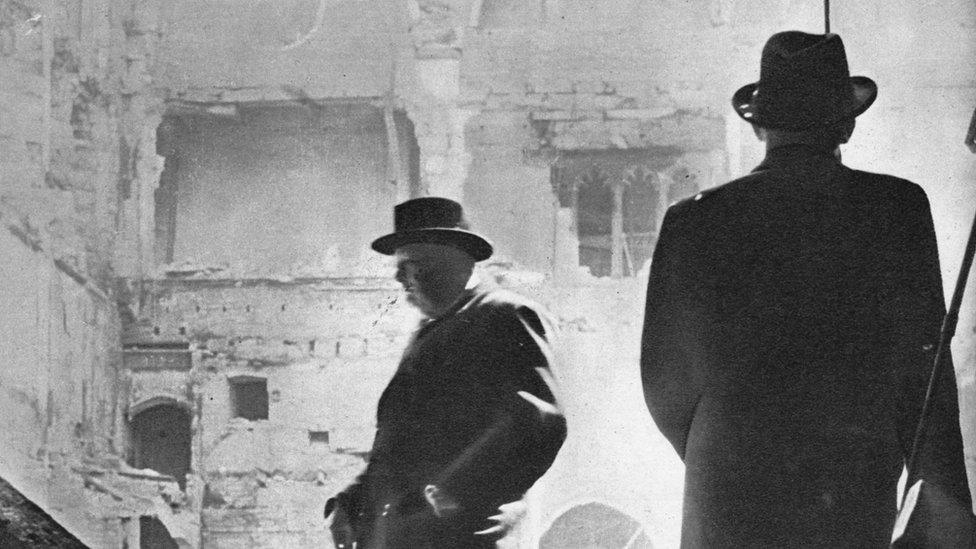
Was Churchill a singleton?
One of the best perks of think tank life is occasionally having time to think.
In 2025 I took a month or two to read a stack of books pursuing the answer to a personal question: was Winston Churchill a singleton?
From the wilderness of the 1930s he prepared for both the war and the power it would bring him, and when that came in May 1940 he used it at once, before the situation was lost: refusing to bargain with Hitler, retrieving the army from Dunkirk, rallying morale and executing a strategy to endure the Blitz, feed Britain, out-invent Germany and bring in America for the definitive stroke.
In other words, is there another “instance in history of a single man—especially a man who is not an absolute monarch—orchestrating the political, economic, cultural, and military means necessary to achieve victory and prosperity no matter the cost”? It turns out, yes! (That quote is about Themistocles.)
Since I quickly learned he wasn’t a one-off, I began to wonder what repetitions of this pattern through history might teach us about preparing for our own looming crises, above all AI, which I believe strongly is the single most determinative force shaping our coming history. Those of us laboring toward a collectively tolerable future with AI are a relatively small community, and history is one of the few data sets we have on how crises like this actually unfold. We draw on it less well than we should: our recall of history is thin; our theories of change are unrealistic; and our strategies are, at best, “imperfectly coherent”. What follows is an attempt to add some of the missing context.
My approach was an informal, biographical case-control study: six matched pairs of named people who either succeeded in bending the arc of a strategic crisis in a favorable direction through anticipatory action, or failed to.
The original intent was to write this up as a semi-scholarly work for publication. But, “ain’t nobody got time for that.” So instead I’ll distill it into blog posts, using the magic of “recursive Pareto” (the 80/20 rule applied to itself many times) — theoretically extracting half the value of the original work with 1% of the effort (Hardy 2010).
| Effort | Time | Output |
|---|---|---|
| 100% | 1 year | 50-page polished thesis |
| 20% | 2.5 months | 40-page unpolished manuscript |
| 4% | 2 weeks | 25 pages of draft |
| ~1% | 2 days | < 20 pages of blog material |
The cases
Six pairs, stretching from Marathon (490 BCE) to Manhattan (2008 CE).
In each, one person bent a strategic crisis toward a better outcome and the other did not.
| # | Crisis | Succeeded | Failed | Core sources |
|---|---|---|---|---|
| i | Fission to the Manhattan Project, 1939–42 | Vannevar Bush: won FDR’s sign-off for NDRC (June 1940), then turned Britain’s MAUD findings into a bomb program by Dec 1941. | Leó Szilard: drafted the Einstein letter (Aug 1939), which yielded only the Briggs committee and $6,000. | Rhodes 1986; Zachary 1997; Bush 1970; Norris 2002. Supporting, on Loomis and radar: Conant 2002; Buderi 1996 |
| ii | Invasions of Athens: Persia, 490–480 BCE; Macedon, c. 352–338 BCE | Themistocles: spent the Laurium silver on a fleet (c. 483 BCE), then lured Xerxes into the straits at Salamis. | Demosthenes: warned against Philip for two decades, but unable to convert the Theoric Fund for defense until 339 BCE, a year before Chaeronea. | Plutarch, Themistocles; Smith 2021; Hammond 1994; Sealey 1993; Clemenceau 1926 |
| iii | U.S. mobilization, 1940–41; rubber shortage, 1942–44 | William Knudsen: left GM in May 1940 and used his Detroit network to convert auto plants to arms before Pearl Harbor. | Jesse H. Jones: held the RFC’s purse and stalled the rubber stockpile and synthetic program until Japan cut off 97% of supply (1942). | Herman 2012; Field 2022; Field 2025; Baruch Committee 1942; WPB 1945; Landon-Lane & Rockoff 1996 |
| iv | Great Inflation, 1979; Crash and Depression, 1928–33 | Paul Volcker (with Milton Friedman): Fed chair from Aug 1979; targeted the money supply and rode out a deep recession to break inflation. | Benjamin Strong (with John Maynard Keynes): the Fed’s dominant figure died in 1928; the Fed then let money contract, and Keynes’s remedy came too late. | Silber 2012; Friedman & Schwartz 1963 (the Strong story); Kennedy 1999 (Depression sequence, Hoover) |
| v | Soviet collapse and loose nukes, 1989–91 | Ash Carter: co-wrote Soviet Nuclear Fission (Nov 1991), the case for Nunn-Lugar, passed weeks before the USSR dissolved. | Andrew Marshall and Brent Scowcroft: Marshall read the Soviet burden correctly but, walled off in the Pentagon, didn’t shape executive preparation; Scowcroft’s NSC kept collapse planning to a small secret group under Rice. | Carter 2019; Carter et al. 1991; Krepinevich & Watts 2015; Berkowitz 2008; Arbel & Edelist 2003; Stimson Center 2023; Bush & Scowcroft 1998; Fischer 1999 (declassified CIA estimates); Gates 1999 |
| vi | Housing bubble to financial crisis, 2005–08 | Ben Bernanke: a Depression scholar, chair from Feb 2006; in 2008 used the Fed’s balance sheet at unprecedented scale to avoid a repeat. | Alan Greenspan: Rajan warned at Jackson Hole (Aug 2005) that finance had grown riskier; the room, there to honor Greenspan, dismissed him. | Tooze 2018; Rajan 2005; Bernanke 2015; Eichengreen & O’Rourke 2012 |
TLDR;
Foresight turned out to be cheap, and nearly useless on its own. Almost every pair includes someone who saw the crisis coming, was right, and mostly lost. Those who succeeded followed Churchill’s arc: they effectually prepared for the crisis, engineering the authority it might hand them, recognizing the moment when it came, and acting while the situation could still be retrieved. Those who fell short had one piece without the others. Szilard had the warning but not the access; Demosthenes, the rhetoric but not the money; Jones, the money but not the foresight; Strong, the authority but not the time; Marshall, the foresight but not a seat in the Oval; Rajan, the warning but not the power, while Greenspan had the power but no ear for the warning. Those who succeeded held the whole set at once: foresight, a remedy others would accept, groundwork laid in advance, the authority and standing to act, and the stamina to see it through.
Coming up
Each post that follows will take these pairs one at a time, starting with Szilard and Bush.
References
Books
- Arbel, David, and Ran Edelist. 2003. Western Intelligence and the Collapse of the Soviet Union, 1980–1990: Ten Years That Did Not Shake the World. London: Frank Cass.
- Bernanke, Ben S. 2015. The Courage to Act: A Memoir of a Crisis and Its Aftermath. New York: W. W. Norton.
- Buderi, Robert. 1996. The Invention That Changed the World: How a Small Group of Radar Pioneers Won the Second World War and Launched a Technological Revolution. New York: Simon & Schuster.
- Bush, George H. W., and Brent Scowcroft. 1998. A World Transformed. New York: Alfred A. Knopf.
- Bush, Vannevar. 1970. Pieces of the Action. New York: William Morrow.
- Carter, Ashton B. 2019. Inside the Five-Sided Box: Lessons from a Lifetime of Leadership in the Pentagon. New York: Dutton.
- Churchill, Winston S. 1948. The Gathering Storm. Vol. 1 of The Second World War. Boston: Houghton Mifflin.
- Clemenceau, Georges. 1926. Demosthenes. Translated by Charles Miner Thompson. Boston: Houghton Mifflin. First published in French as Démosthène (Paris: Plon, 1926).
- Conant, Jennet. 2002. Tuxedo Park: A Wall Street Tycoon and the Secret Palace of Science That Changed the Course of World War II. New York: Simon & Schuster.
- Field, Alexander J. 2022. The Economic Consequences of U.S. Mobilization for the Second World War. New Haven: Yale University Press.
- Friedman, Milton, and Anna Jacobson Schwartz. 1963. A Monetary History of the United States, 1867–1960. Princeton: Princeton University Press.
- Goldhamer, Herbert. 1978. The Adviser. New York: Elsevier.
- Hammond, N. G. L. 1994. Philip of Macedon. London: Duckworth.
- Herman, Arthur. 2012. Freedom’s Forge: How American Business Produced Victory in World War II. New York: Random House.
- Jungk, Robert. 1958. Brighter than a Thousand Suns: A Personal History of the Atomic Scientists. Translated by James Cleugh. New York: Harcourt, Brace. First published in German as Heller als tausend Sonnen, 1956.
- Kennedy, David M. 1999. Freedom from Fear: The American People in Depression and War, 1929–1945. Oxford History of the United States. New York: Oxford University Press.
- Kissinger, Henry. 2022. Leadership: Six Studies in World Strategy. New York: Penguin Press.
- Krepinevich, Andrew F., and Barry D. Watts. 2015. The Last Warrior: Andrew Marshall and the Shaping of Modern American Defense Strategy. New York: Basic Books.
- Norris, Robert S. 2002. Racing for the Bomb: General Leslie R. Groves, the Manhattan Project’s Indispensable Man. South Royalton, VT: Steerforth Press.
- Pareto, Vilfredo. 1896–97. Cours d’économie politique. 2 vols. Lausanne: F. Rouge.
- Plutarch. Life of Themistocles.
- Rhodes, Richard. 1986. The Making of the Atomic Bomb. New York: Simon & Schuster.
- Sealey, Raphael. 1993. Demosthenes and His Time: A Study in Defeat. New York: Oxford University Press.
- Silber, William L. 2012. Volcker: The Triumph of Persistence. New York: Bloomsbury Press.
- Smith, Jeffrey A. 2021. Themistocles: The Powerbroker of Athens. Barnsley: Pen and Sword Military.
- Tooze, Adam. 2018. Crashed: How a Decade of Financial Crises Changed the World. New York: Viking.
- Zachary, G. Pascal. 1997. Endless Frontier: Vannevar Bush, Engineer of the American Century. New York: Free Press.
Articles, papers and reports
- Aschenbrenner, Leopold. 2024. Situational Awareness: The Decade Ahead. June 2024.
- Berkowitz, Bruce D. 2008. “US Intelligence Estimates of the Soviet Collapse: Reality and Perception.” International Journal of Intelligence and CounterIntelligence 21 (2): 237–250.
- Carter, Ashton B., Steven E. Miller, Charles A. Zraket, and Kurt M. Campbell. 1991. Soviet Nuclear Fission: Control of the Nuclear Arsenal in a Disintegrating Soviet Union. Cambridge, MA: Belfer Center, Harvard Kennedy School. November 1991.
- Eichengreen, Barry, and Kevin H. O’Rourke. 2012. “A Tale of Two Depressions Redux.” VoxEU, CEPR.
- Field, Alexander J. 2025. “The World War II US Rubber Famine.” Working paper, Santa Clara University. SSRN 5405045, August 25, 2025.
- Hardy, Michael. 2010. “Pareto’s Law.” Mathematical Intelligencer 32 (3): 38–43.
- Hendrycks, Dan, Eric Schmidt, and Alexandr Wang. 2025. “Superintelligence Strategy: Expert Version.” arXiv:2503.05628.
- Kokotajlo, Daniel, Scott Alexander, Thomas Larsen, Eli Lifland, and Romeo Dean. 2025. AI 2027 (“Slowdown” ending).
- Landon-Lane, John, and Hugh Rockoff. 1996. “The Paradox of Planning: The Controlled Materials Plan of World War II.” NBER Historical Working Paper 83. Rev. 2013.
- Rajan, Raghuram G. 2005. “Has Financial Development Made the World Riskier?” NBER Working Paper 11728.
- ‘t Hart, Paul, Uriel Rosenthal, and Alexander Kouzmin. 1993. “Crisis Decision Making: The Centralization Thesis Revisited.” Administration & Society 25 (1): 12–45.
Government documents
- Fischer, Benjamin B., ed. 1999. At Cold War’s End: US Intelligence on the Soviet Union and Eastern Europe, 1989–1991. Washington, DC: CIA Center for the Study of Intelligence.
- Gates, Robert M. 1999. “US Intelligence and the End of the Cold War.” Speech, Texas A&M University, November 1999.
- U.S. Special Committee to Study the Rubber Situation (Baruch Committee). 1942. Report of the Rubber Survey Committee. Washington, DC: GPO. September 10, 1942.
- U.S. War Production Board. 1945. Wartime Production Achievements and the Reconversion Outlook: Report of the Chairman. Washington, DC: GPO. October 9, 1945.
Web and press
- Caruso, Gregg D. “Skepticism About Moral Responsibility.” Stanford Encyclopedia of Philosophy.
- Harvard Belfer Center. Applied History Project.
- “Nuclear Terrorism: Did We Beat the Odds or Change Them?” NDU Press.
- PBS. “Jesse Jones” biography.
- Stimson Center. 2023. “Soviet Collapse and Nuclear Dangers: Harvard and the Nunn-Lugar Program.”
- Teaching American History. Gallup Polls, January 1940 – January 1941.
- Washington Post. 1979. “Soviets Had Chance to Develop First A-Bomb, Historian Says.” July 27, 1979.
- Wikipedia. “Structure and Agency.”

