

In the policy circles in which I pretend to operate, 2025’s “AI as Normal Technology” felt like a refreshing breeze of sanity after contemporary “doomer” gusts: https://situational-awareness.ai/ and https://ai-2027.com/
One thing I especially appreciated about “AINT” was it made some (nearly) falsifiable predictions:
We offer a prediction based on this view of human abilities. We think there are relatively few real-world cognitive tasks in which human limitations are so telling that AI is able to blow past human performance (as AI does in chess).
In many other areas, including some that are associated with prominent hopes and fears about AI performance, we think there is a high “irreducible error”—unavoidable error due to the inherent stochasticity of the phenomenon—and human performance is essentially near that limit.Concretely, we propose two such areas: forecasting and persuasion. We predict that AI will not be able to meaningfully outperform trained humans (particularly teams of humans and especially if augmented with simple automated tools) at forecasting geopolitical events (say elections). We make the same prediction for the task of persuading people to act against their own self-interest.
Today while futilely trying to stay caught up on reading, I noticed two interesting updates:
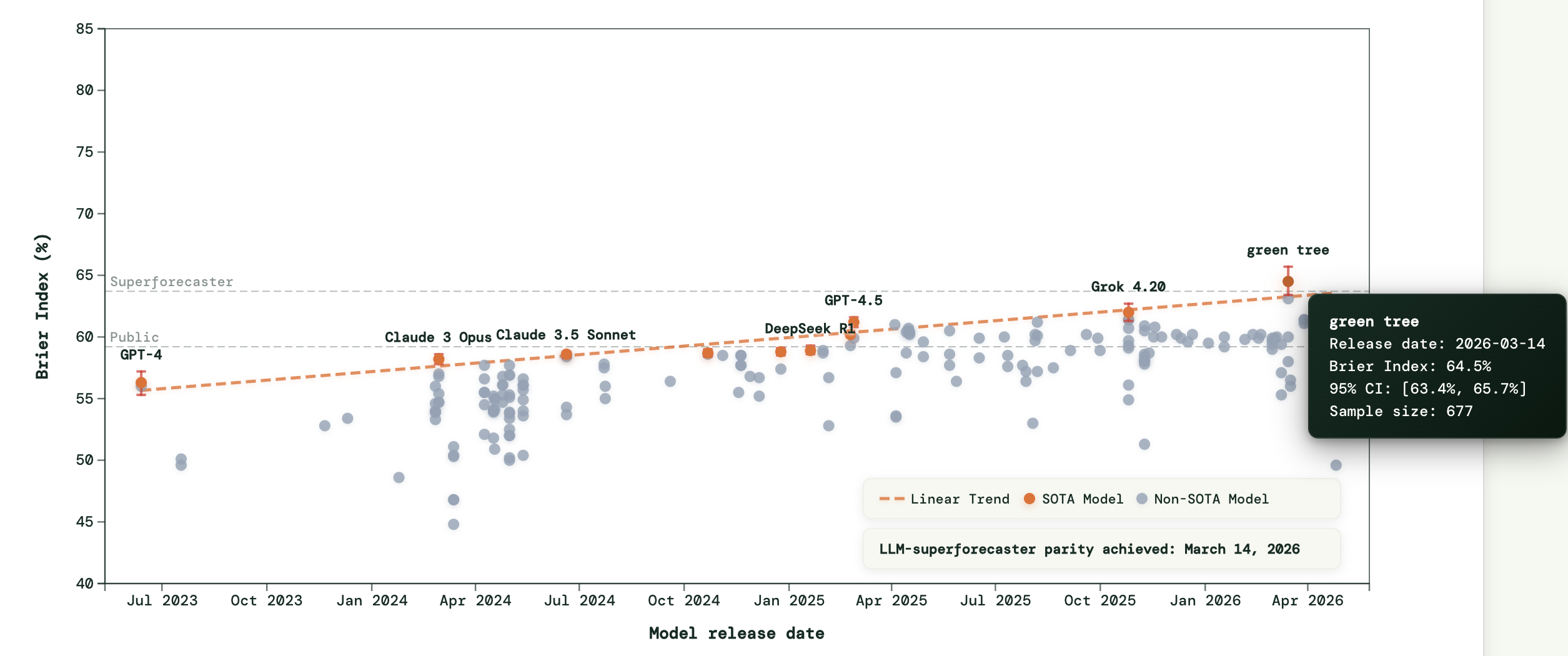
- On ForecastBench, which measures LLM forecasting ability with leak-resistant prediction benchmarks, AI parity with the median superforecaster was recently achieved.
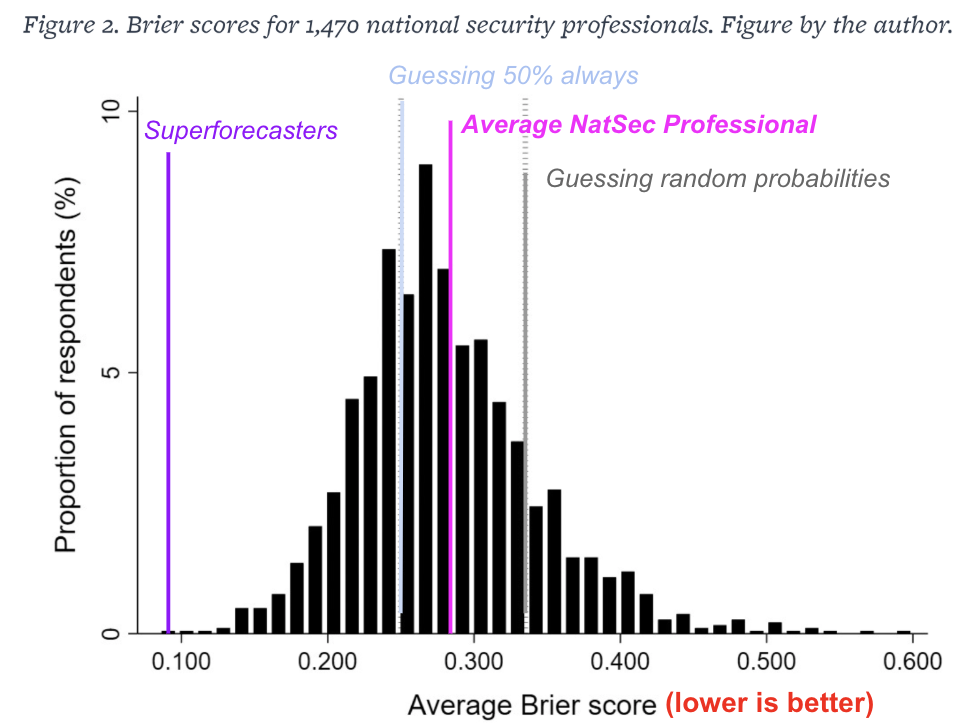
This is especially impressive given what we know about the remarkably poor baseline performance of even notionally expert humans at geopolitical forecasting: (NB: my kluge-y annotation of figure from the paper)
2. And last week’s preprint “AI systems out-persuade expert humans” found that:
“in a series of four preregistered experiments (n = 18,978 conversations from 6,923 people), we pitted AI systems against a range of human persuaders, including laypeople, winners of a separately preregistered four-round online persuasion tournament, professional canvassers, and world championship debaters. We found that AI systems were reliably more persuasive than expert humans, even when expert humans chose their issues, researched in advance, underwent hours of live, structured practice, and were incentivized with £1,000 cash bonuses. … In a final study, we show that AI’s advantage extends to consequential real-world behavior: AI was nearly 3x more effective than professional canvassers from a UK fundraising firm at raising real-money donations to Save the Children. Together, these results establish that frontier AI systems out-persuade expert humans in conversation, with significant implications for political communication.”
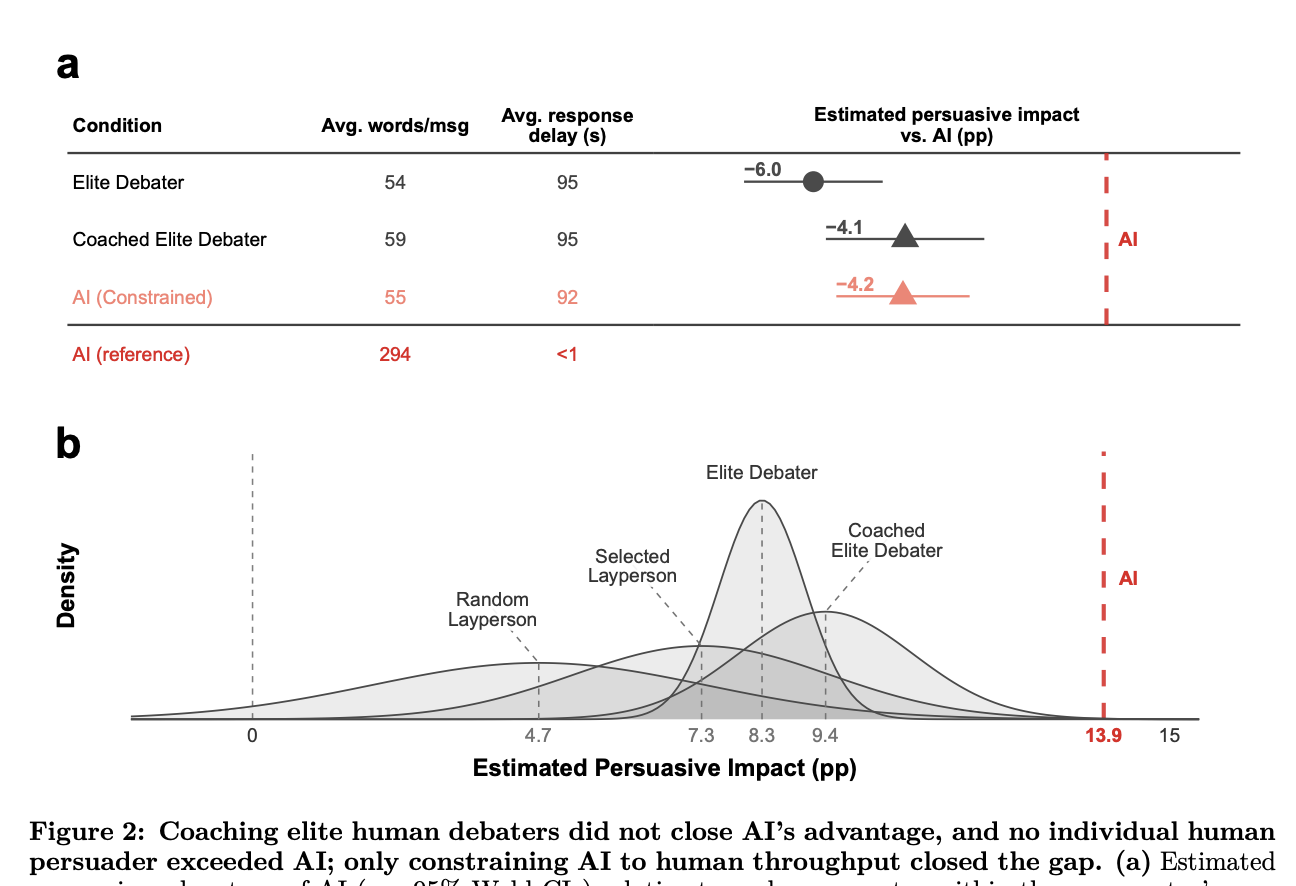
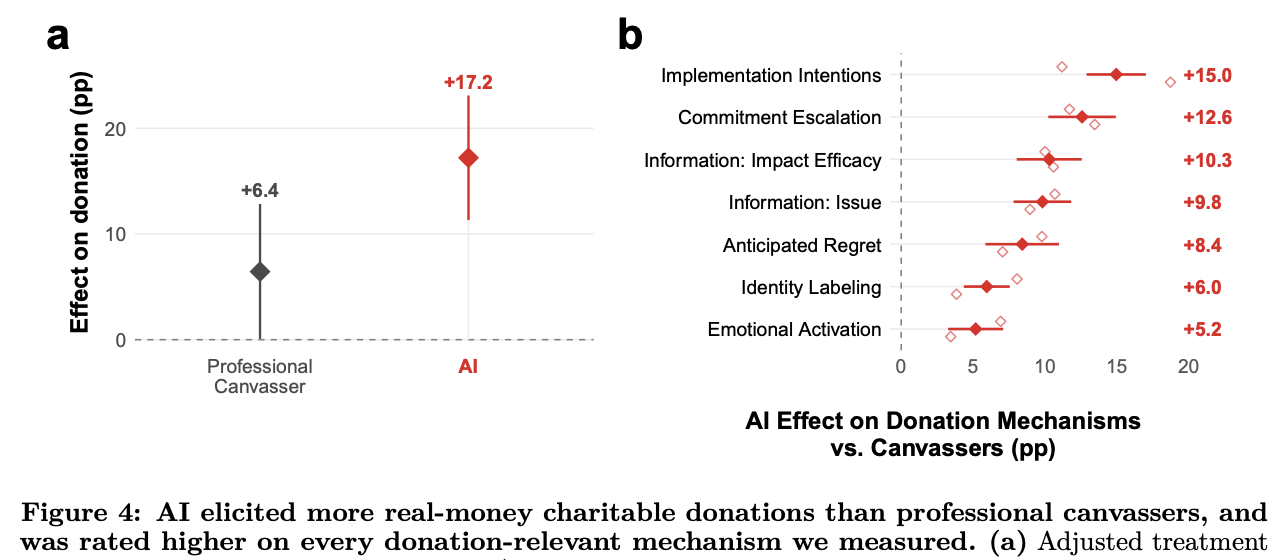
While neither of these results is enough to refute AINT’s two concrete predictions, this does seem like significant evidence against being surprised to see these falsified soon— especially given both studies used models already a generation or so out of date…
I reckon this also bodes poorly for AINT’s implicit third prediction:
“We think there are relatively few real-world cognitive tasks in which human limitations are so telling that AI is able to blow past human performance“, which emits at least a faint whiff of ‘On the Impossibility of Supersized Machines‘.
So I would bet the authors $100 USD [2026] that by the end of CY 2030:
1) AI systems will meaningfully outperform trained humans (including teams augmented with simple [2025] automated tools) at forecasting geopolitical events
2) AI systems will be demonstrably superhuman at the task of persuading [2025] people to act against their own self-interest
3) There will be relatively few real-world cognitive tasks in which AI is not able to blow past [2025] human performance
This is a wager I hope to lose, but fear I will win.

