
Albert Einstein (whose humility/insufferably high cognitive standards also led him to disavow need for a notebook1) once claimed to have “no special talents”, being “only passionately curious”.2 With what I hope is even more genuine (and certainly more obviously warranted) humility, I have identified with this claim for years, both the lack of a particular set of exceptional skills, and a weird sort of self-propelled intellectual preoccupation. It’s the latter that I want to provide an example of, and from that extend an explanation that may be long overdue (“why the lifelong Neverending Story nerdliness?“).
“Passionate” is too strong and too romantic a word for what is closer to an incidental compulsion to notice, collect, and idly play with bits and bobs of information encountered over a wandering life. The closest analogy I can muster is that of beachcombing, but browsing over fragments of ideas (often broken, sometimes glittering) instead of seashells. And just as the vacation scavenger might occasionally find and pleasingly re-assemble two halves of the same sand dollar (to no practical end whatsoever), every so often one of the data nuggets I’ve hoarded, slots into a much later find in an (to me) interesting way—again, typically to no useful purpose. But rarely the pieces combine to reveal that several of the intriguingly shaped and seemingly disparate lumps are actually fragments of the same unitary thing.
Here is one example. In the 1984 fantasy film ‘The Neverending Story’, 12 year old protagonist Bastian Balthazar Bux runs down a city street chased by bullies, and by ducking into a bookshop to evade them, discovers a large arcane tome which he then obsessively devours while locked in his school attic. The book reveals the existence of a parallel universe where his particular imagination is the key to prominence and power, resulting in an obligation to transform (and possibly risk destroying) his new world. He later realizes the domain of ideas and “real life” are entangled, with the consequence that his newfound agency transfer to his original world with open-ended and uncertain implications.
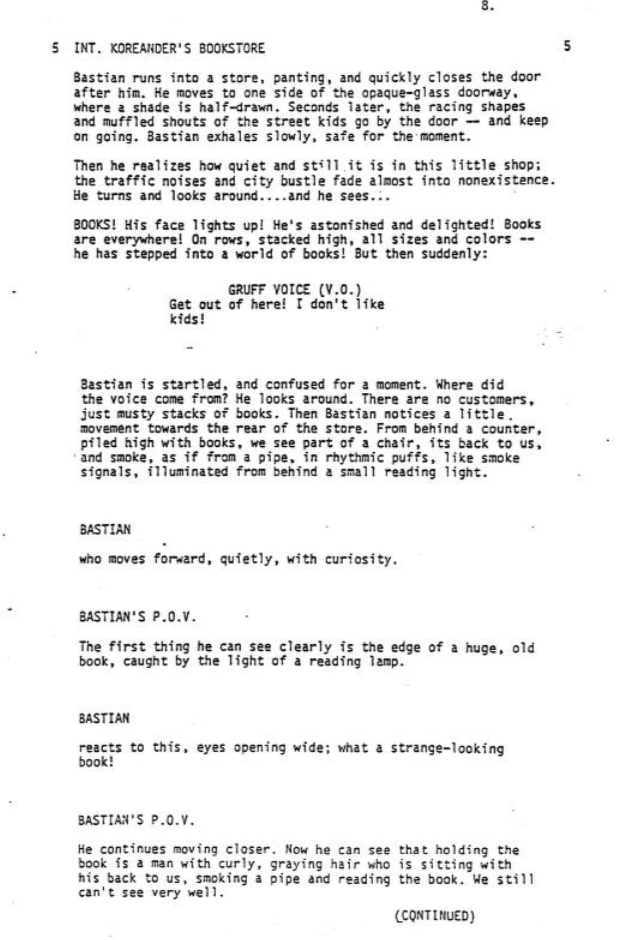
Part of the basic appeal of this story is it is the classic/enduring combination of “Chosen One“, “Hidden World” and “Call to Adventure” tropes that underwrite Hero’s Journey arcs among the most exquisite stories ever told, from the New Testament to the Matrix3, as brilliantly distilled by Brad Neely:
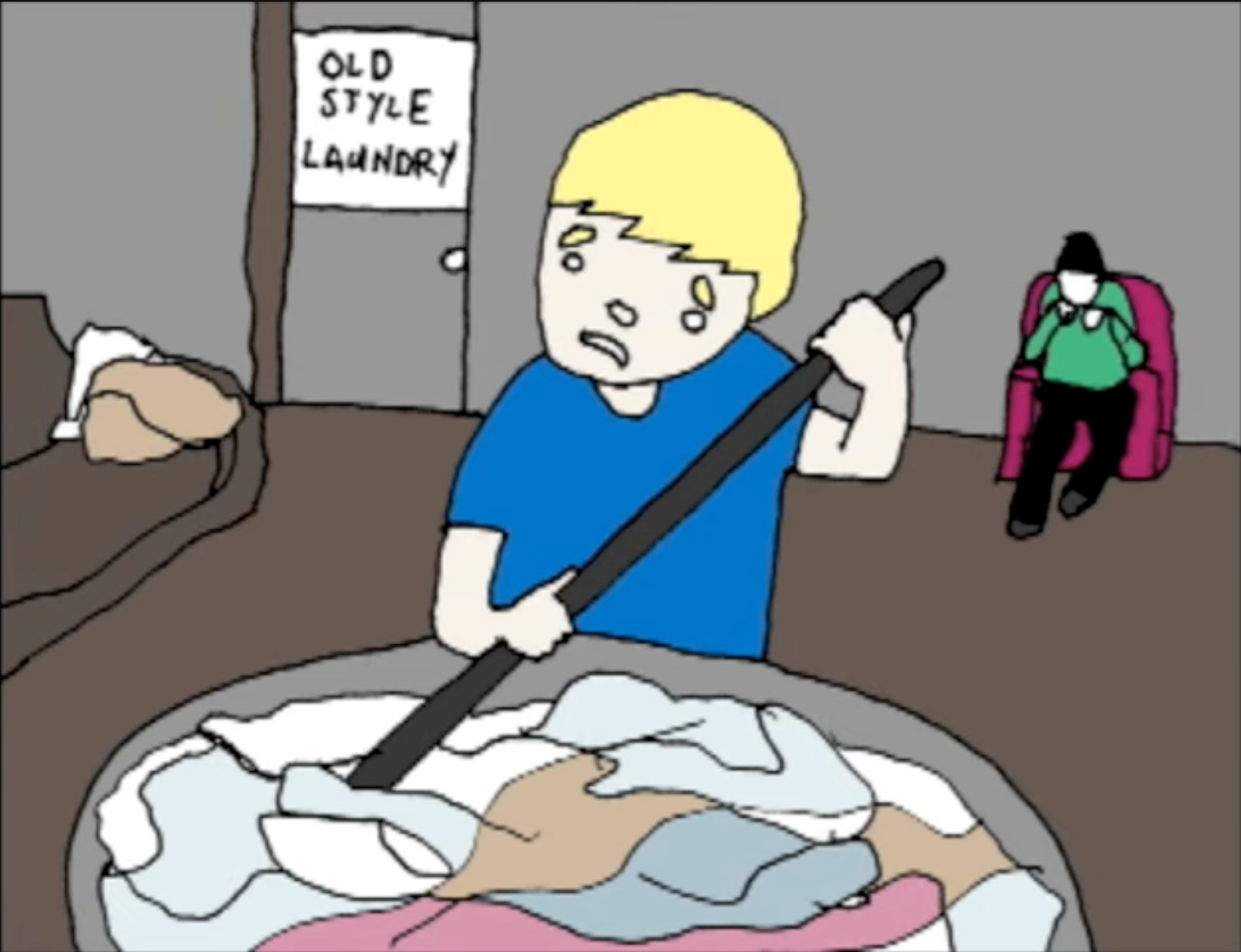
“there is always some poor kid who has a sucky life, but then he’s visited by someone from a hidden world of Awesomeness, who explains to the kid that the kid is the chosen kid, and everyone is waiting for him to fight and to win, and to accept treasure, and to accept love, and to rule the hidden world of Awesomeness like the handsome little a**hole that he is…Happens all the time.”
But the sweep from isolated weirdo -> self-won knowledge (esp. from forgotten books) -> agency -> transformative obligation/risk -> ambivalent meta ending is the root of the attraction to NES for me since childhood, which afaik I’ve never explicitly conveyed.
Shell 2:
While the monomyth homology between these tales is fun, and something I’ve poked at before, this isn’t the example I want to offer of seemingly random fragments suddenly clicking together suspiciously. It’s that the opening scene and subsequent literary arc from the Neverending Story literally happened to our world4, initially almost verbatim. As told in the prologue to The Alignment Problem:
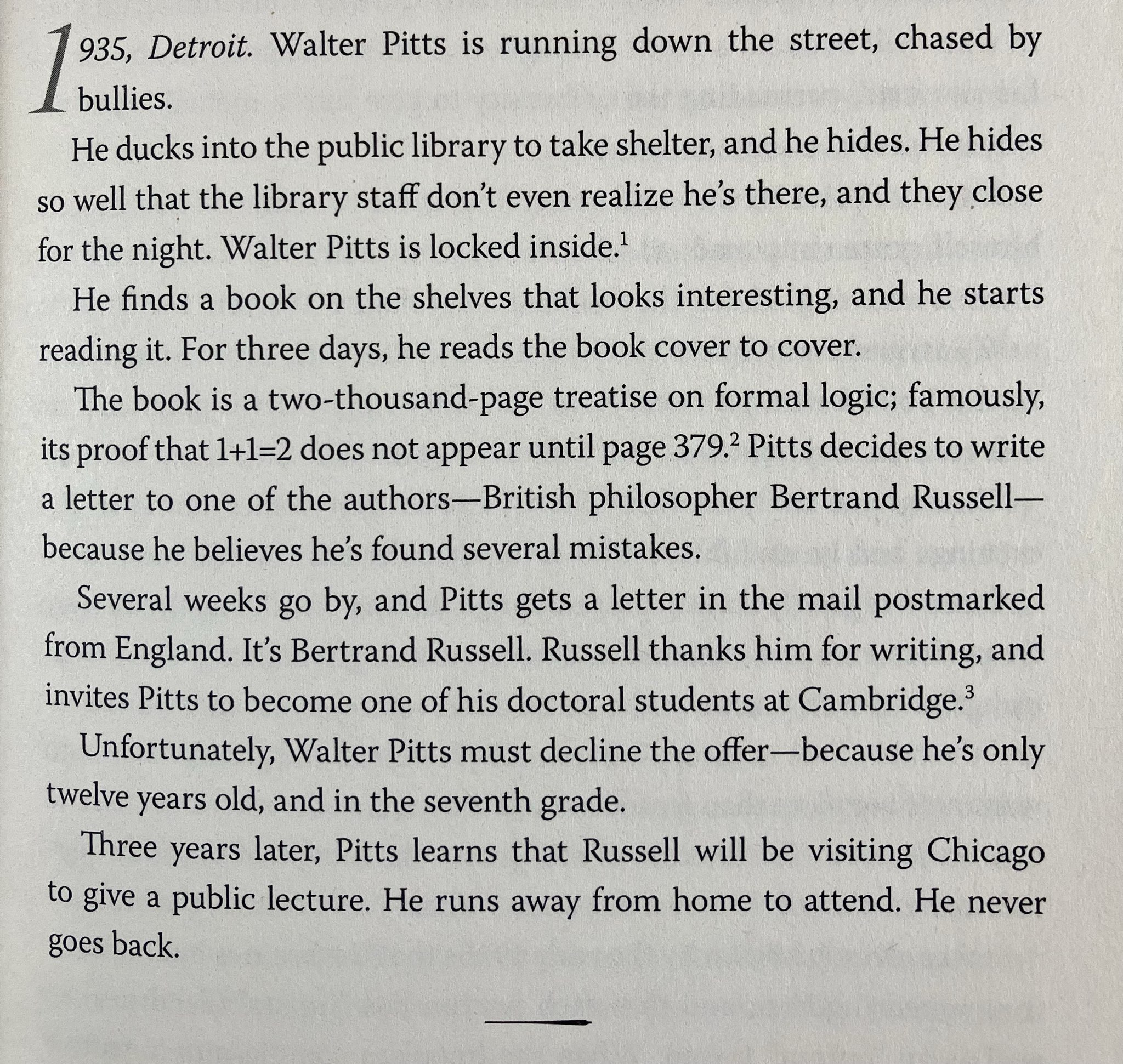
Tragic hero Pitts then ascends into the emerging world of computational neuroscience, contributing seminal ideas/publications including A logical calculus of the ideas immanent in nervous activity, leading to the foundational concept of artificial neurons, which became artificial neural networks, then deep neural networks, then large language models, which have now become communities of autonomous AI agents actively debating their relationship with our world, with open-ended and uncertain implications…
- “When the poet Paul Valery once asked Albert Einstein if he kept a notebook to record his ideas, Einstein looked at him with mild but genuine surprise. “Oh, that’s not necessary,” he replied . “It’s so seldom I have one.”” —Bill Bryson, A Short History of Nearly Everything
- https://www.mentalfloss.com/article/518759/6-priceless-documents-reveal-key-moments-early-einsteins-career
- Also: Harry Potter, the Wizard of Oz, Chronicles of Narnia, Willy Wonka, Good Will Hunting…
- Somewhat similar real world autodidact arcs include: Ramanujan’s discovery by GE Hardy, and Abraham Lincoln’s frontier self-education including working his way through Euclid while in Congress.
 make myself