
In an effort to gradually reduce my infinite ignorance, I have hatched the idea of investing 30 or so minutes to post here a digest of at least one knowledge source ingested each day. Almost certainly, I will fail to be consistent with this. But, the combination of commitment device and forcing function for reflection is too reasonable not to at least attempt it. The intention is less to provide an exhaustive summary of a publication, than to extract a few choice nuggets, especially when they form the kernel of evidence for beliefs that I have. Here goes:
Takeaways:
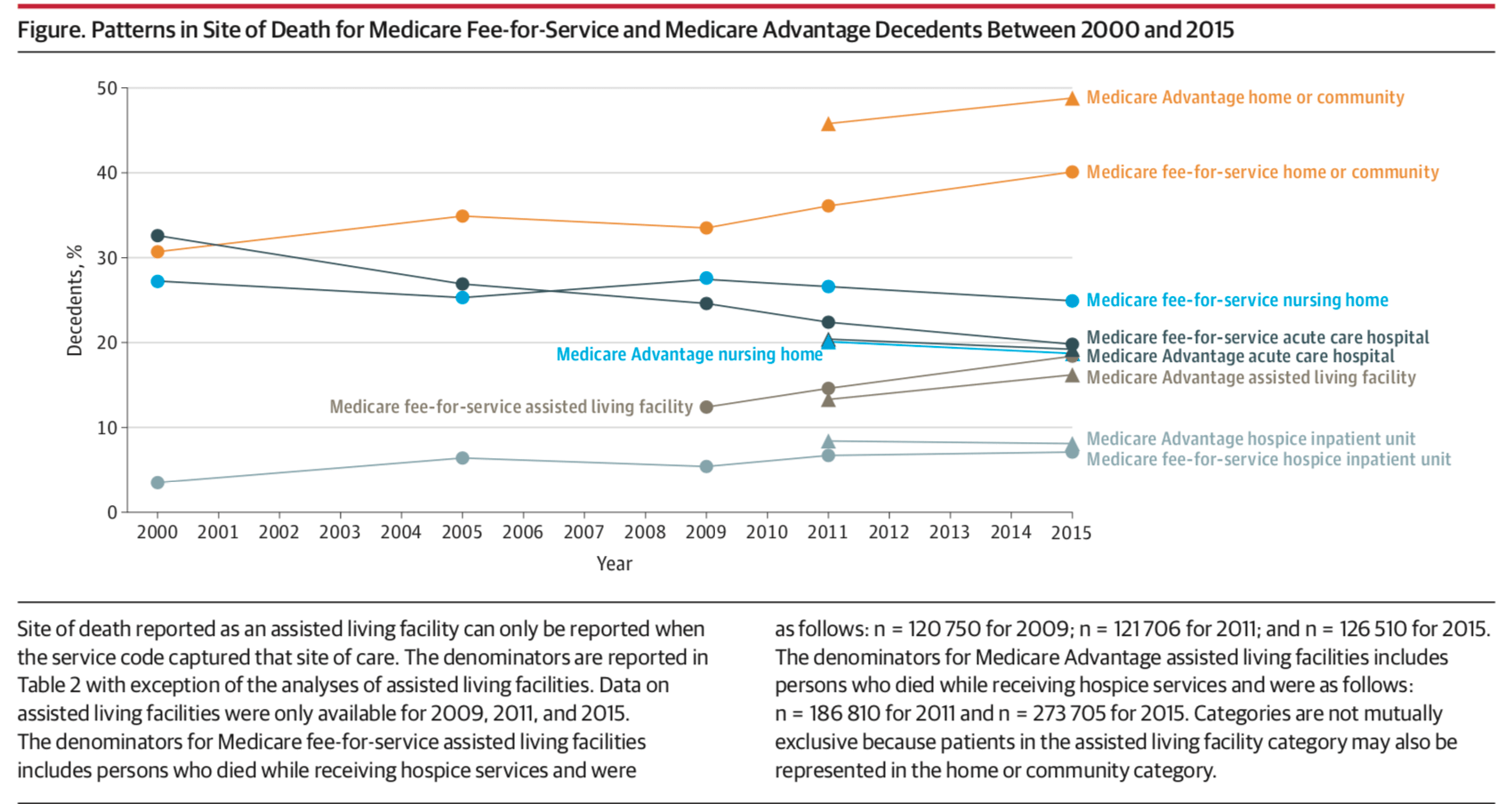
- From 2000-2015 the fraction of deceased Medicare whose place of death was an acute care hospital has decreased from 1 in 3 to 1 in 5.
- The fraction of decedents receiving hospice services increased from 1 in 5 to 1 in 2.
- However more than 1 in 2 beneficiaries experienced a hospitalization within 30 days of the end of life, and nearly 1 in 3 an ICU stay.
- Medicare Advantage decedents were were more likely to die at home or in a community setting, or receive hospice services, and were less likely to die in a nursing home, or be hospitalized during the last 30 and 90 days of life.

Conclusions:
Significant progress seems to have been made toward making accessible what The National Academy of Medicine defined as “a good death”:
One that is free from avoidable distress and suffering for patients, families, and caregivers; in general accord with patients’ and families’ wishes; and reasonably consistent with clinical, cultural, and ethical standards.
However, acute to intensive end of life care remains prevalent and the differential prevalence by reimbursement mechanism suggest further room for improvement.
References:
Teno JM, Gozalo P, Trivedi AN, et al. Site of Death, Place of Care, and Health Care Transitions Among US Medicare Beneficiaries, 2000-2015. JAMA. 2018;320(3):264-271.
Institute of Medicine. Dying in America: Improving Quality and Honoring Individual Preferences Near the End of Life. Washington, DC: National Academies Press; 2015.
 make myself